
I find the same thing happens to me over and over. Faced with a problem, I come up with a massively overengineered solution. After taking time away and reviewing with fresh eyes, a far more elegant and almost always blatantly obvious solution presents itself.
A cycle I have once again endured with regard to designing The Five Fates – a lore inspired tavern minigame that I first introduced back in November 2025.
Picking up where I’d left off (debating the merits of a neural network to test out the limits of my chess / sumo-wrestling hybrid board game), as time went on and I’d muse on the game, it felt too… slow. Too clunky.
Having already learned my lesson – without the help of a neural network – I set out once more to look at existing games instead of trying to magic my own up out of thin air. It knew it had to be fast and easy to understand.
Lightbulb moment: It had to be a dice game.
Coming up with the setup was simple – 5 dice (to match the five different fates). On the face that would usually have 6 pips is instead an icon representing each fate.
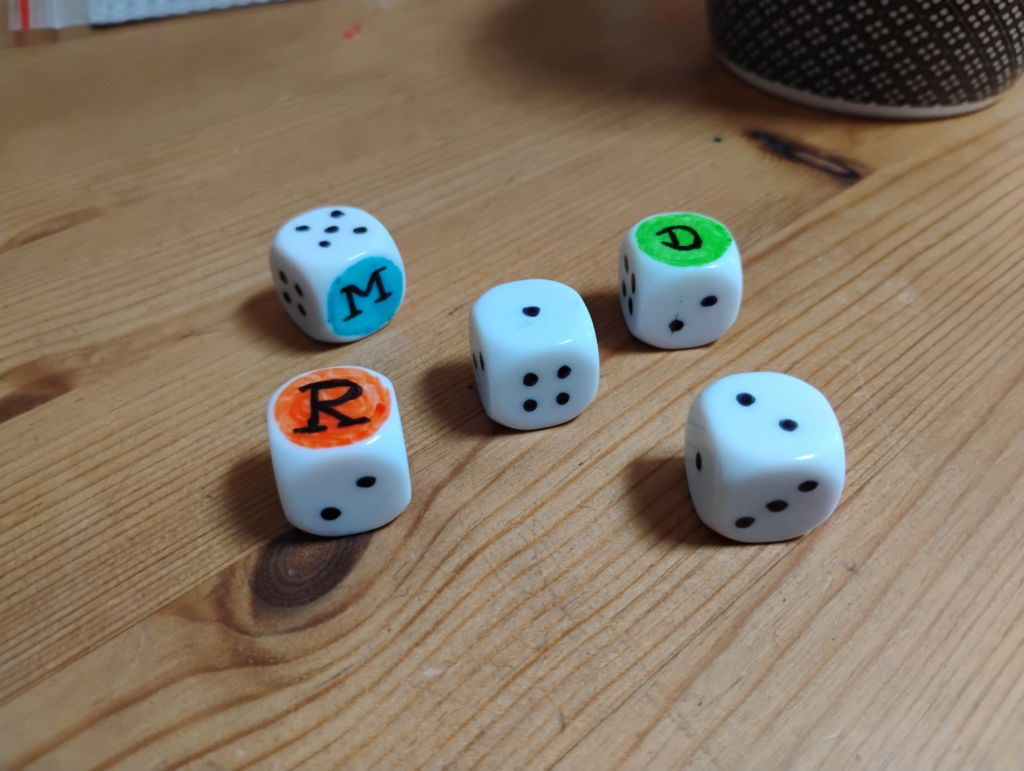
Before I trapped myself in another rabbit hole, I thought I’d do some research and see how mediaeval ragamuffins would swindle each other out of a few coins at their local tavern.
Knights, Hazards and Craps
I’m not much of a gambler, so I’d never heard of Craps before. At least, not as a dice game. If you dig a little deeper into history, Craps is actually the descendent of a medieval dice game called Hazard.
Popular enough to be mentioned in Chaucer’s The Canterbury Tales (written in 1392), Hazard was apparently so popular that knights were known to bet entire estates on the roll of two dice.
After a few hours of rolling my own dice on the kitchen table, I felt like I had the beginnings of something – a ruleset that was simple to understand whilst also leaving room for skilled players (either at knowing the odds or social engineering… or both) to have an edge.
Playtesting The Five Fates… again
Wasting no time, I set up another playtest session with my friends so that I could figure out the viability of The Five Fates. I had originally planned to grab some Monopoly money and take that as a stand-in for cash… until I had a better idea.
Paper money didn’t really feel thematic. This is a game played in taverns and backalleys, after all! We needed something to really sell the immersion.
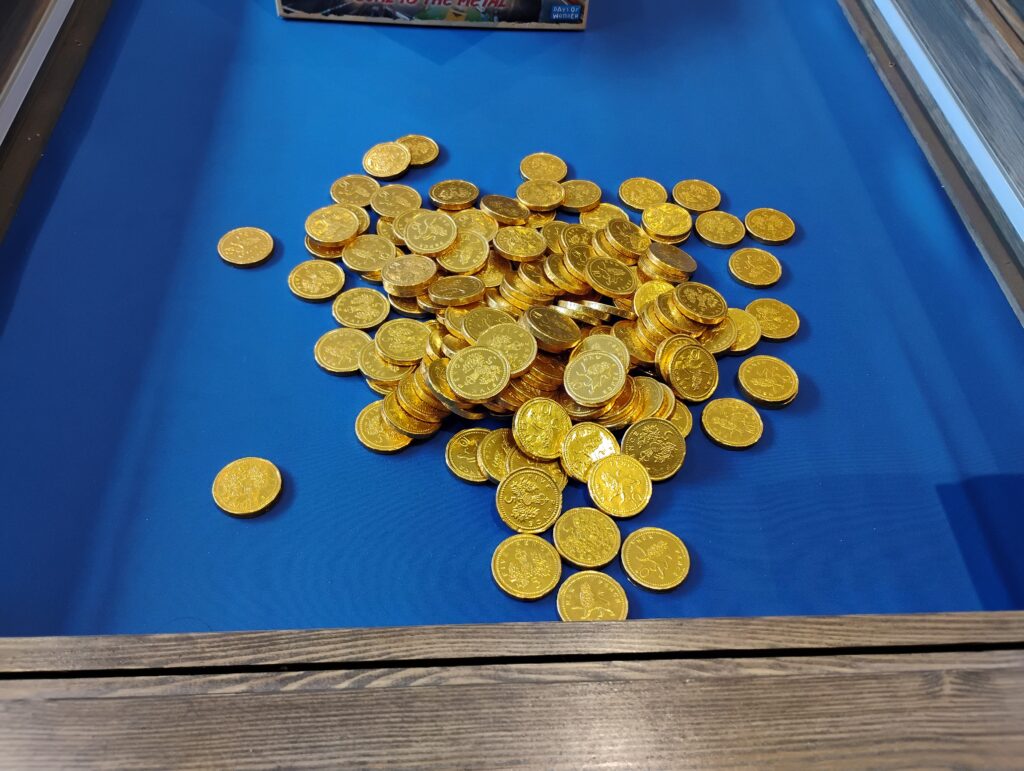
After testing the game with a couple of friend groups, I left with mixed feelings. I’d successfully created a way of gambling in this world that’s thematic and technically hits the brief.
Unfortunately, I don’t think it’d be fun to play in Garrison. In this state, it’s essentially just watching probabilities resolve which isn’t particularly exciting. There was something missing.
So, I once again went away and mused on the game for a little while. I imagined where it’d be played and the types of people in this world that’d play it… and then it hit me.
I needed to add cheating.
Avoiding suspicion
Suddenly I found myself thinking about casinos where the odds are always set against you. Or better yet, those sleight of hand games you see played by street hustlers, trying to trick unsuspecting passers-by into losing some cash.
That’s what I’m trying to capture, except we’ll be allowing the player – if not straight up encouraging the player – to out-cheat the cheaters.
I realise now that I’ve made a game within a game… within a game.
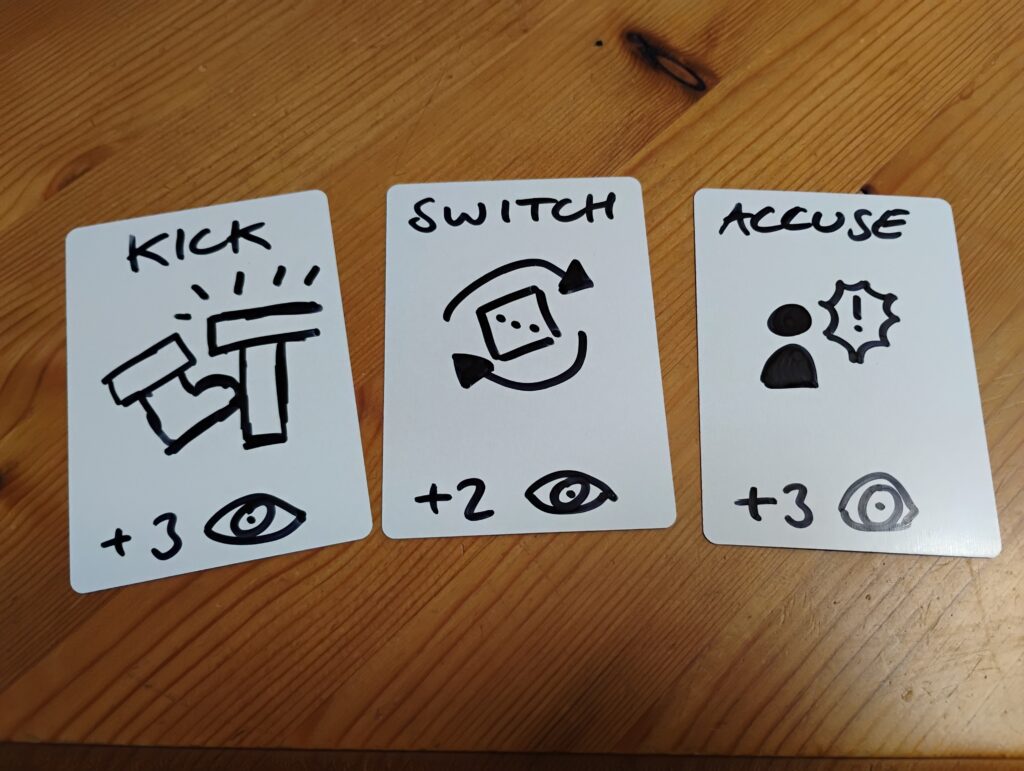
The exact nuance of this latest version will (surprise surprise) need some testing, though I imagine it working by manipulating the values on the die with the Five Fates game. If you get too much ‘suspicion’ from tampering with the values then you’ll get thrown out and lose all your money!
Community Q & A
I’m currently in the process of getting some tattoos lasered off (I was young; it’s a long story) and Marcus, the technician, is actually a really cool guy. He DM’s Dungeons & Dragons for his friendship group! That screams ‘future Garrison enjoyer’ if you ask me.
At my most recent appointment, I was chatting with him about The Five Fates and how much it’s changed from my original concept. Then he hit me with this:
How many times have I had to redesign Garrison?
The answer is a lot. A lot of times. And I imagine we’ll have to do it many more times before the game is finally released.
I will say, though, that it’s not necessarily a complete rework from the ground up. The underlying inspiration for the game hasn’t changed, nor has how we’re building the core gameplay loop.
It’s more about having to constantly adjust how all of the different gameplay features work and interact with each other. As an example, there used to be a mechanic in this game called ‘supply’.
Characters originally had to take some supplies with them on missions and, if they ran out, then they’d start to incur negative effects which compounded over time.
As development has progressed and many other features have been added in, the supply mechanic became a barrier in many different ways – it added something that players had to track which felt unnecessarily complicated, it took up space on the user interface… the more the game was fleshed out and new ideas were introduced, the more the original supply mechanic stuck out.
Eventually I succumbed to the feeling that it didn’t belong and took it out.
More often than not, when I make the decision to remove a feature, it’ll work its way back into the game under a different guise. No idea is ever wasted or dismissed completely!
There’s one part of this game that I’m yet to reveal – the monsters. The first few will be revealed in next month’s devblog, so don’t miss it. Or else.
Cheers, Andrew