
For a game that’s all about fending off monsters, we ain’t even seen one! It’s time for that to change.
Before I get ahead of myself, I wanted to take a moment and thank Hayley Littler who’s been in charge of updating the Venture Forth website. It looks incredible and I’ve been getting a tonne of compliments since the changes went live. I’ve still got a few tweaks to make, however this is a really great step forward.
I had previously been a little hesitant to direct people to the site because it looked… well, awful, to be honest. Now, thanks to this major upgrade, it feels like we’re a proper video game development company.
If we want Garrison to feel like a proper game then we need monsters. Lots of them.
As part of what I called the ‘concept art testing blob’ we focussed on some of the most familiar and expected fantasy RPG monsters. Within our taxonomy there’s a category for what are essentially beasts – some are naturally imposing whereas others have been magically augmented, making them larger and far more dangerous.
Creepy crawly
A lot of human beings have an instinctive, primal fear response when they see a spider. I’d say my relationship with spiders is pretty chill – I’ll generally leave them be, occasionally relocating them if they’re being too bold on my bedroom walls.
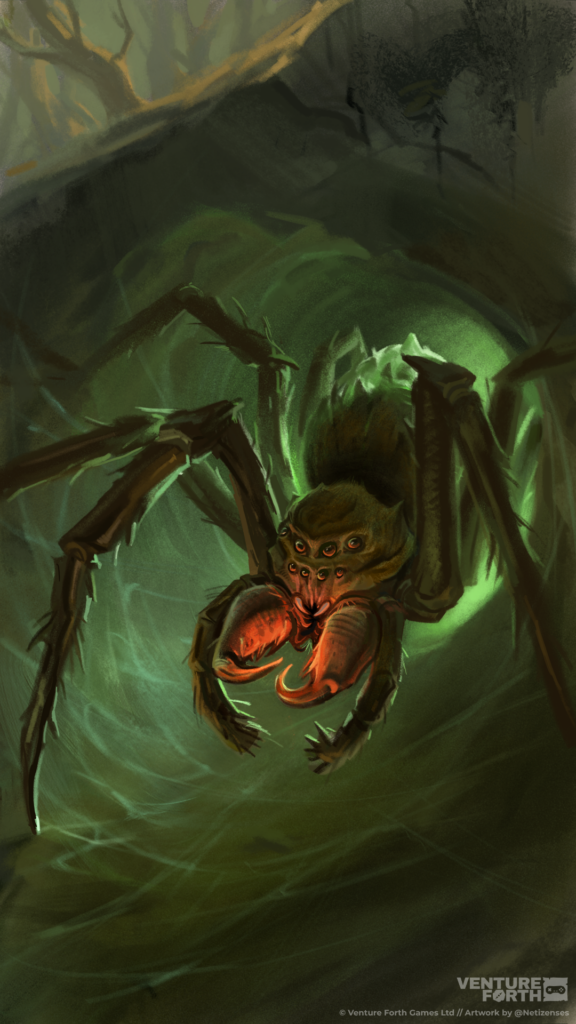
Sophie (artist) is undoubtedly one of the brave exceptions to our species because she LOVES spiders. It should come as no surprise, then, that our spider monster – named Araknos in the taxonomy – is absolutely stunning in both the best and worst ways possible.
Bear hugs
Quite often you’ll have a bear and then, in fantasy games, a ‘dire bear’, which is a much larger and more aggressive version of a normal bear. I wanted to add a third step to that hierarchy (as a result of the aforementioned aethereal tinkering) which I’ve named the Ursok.
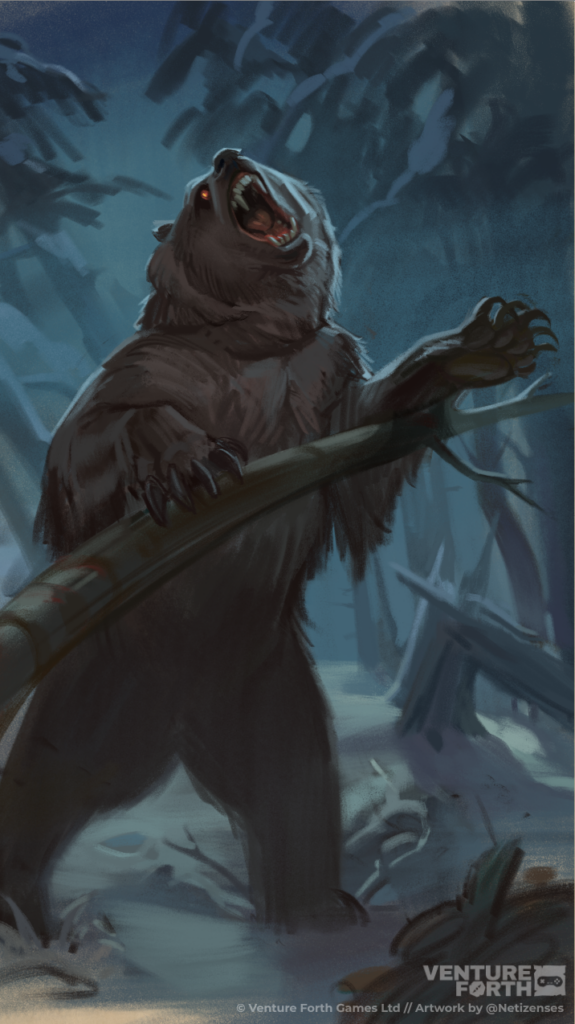
You can expect to encounter this type of monster in forest and mountain areas – perhaps occasionally in coastal areas, too. I really want to try and keep things as realistic as possible so we aren’t going to have anything like lava bears or desert bears. Reskinning existing monsters to create artificial world depth is the exact opposite of what we want this game to be!
Goblin mode
It’s not often you get to put an original spin on something that’s existed for a long time. To the best of my knowledge, that’s what we’ve been able to do with our goblins.
When bouncing around ideas for the artwork, I mentioned that I’d like to have a rare goblin variant called the treasure goblin. The idea being if players defeat it then they get additional treasure – pretty standard in RPGs.
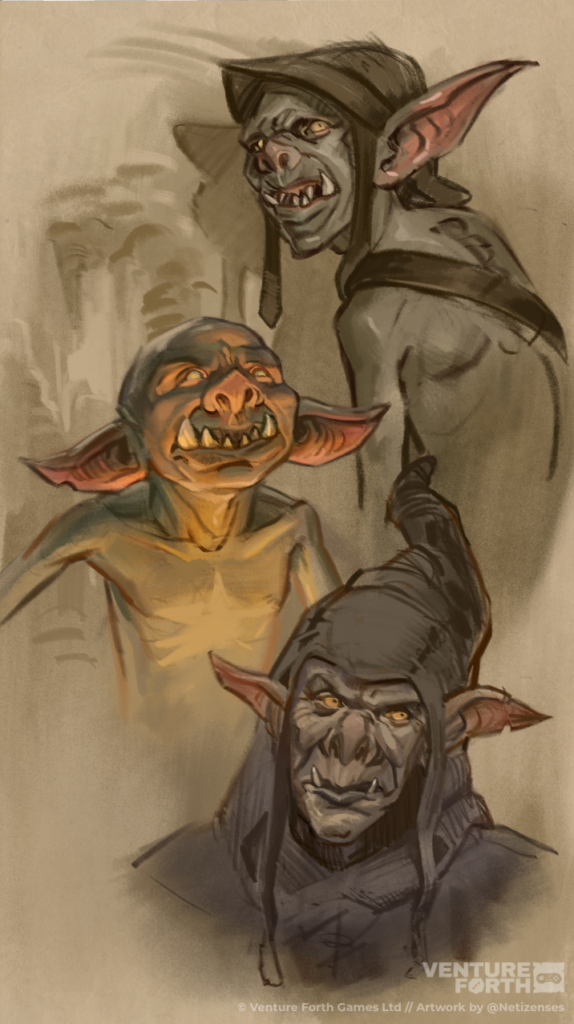
Sophie took that idea and ran with it, essentially creating a goblin sub-species which is more bat-like in appearance and literally sniffs out rare minerals, items, etc. How awesome is that?!
SMALL FRY
Last but certainly not least we have the creatures that’ve haunted my dreams since I first came up with them many, many years ago. Inspired by the deep-sea anglerfish that have those haunting, dead eyes – we have the Murklings.
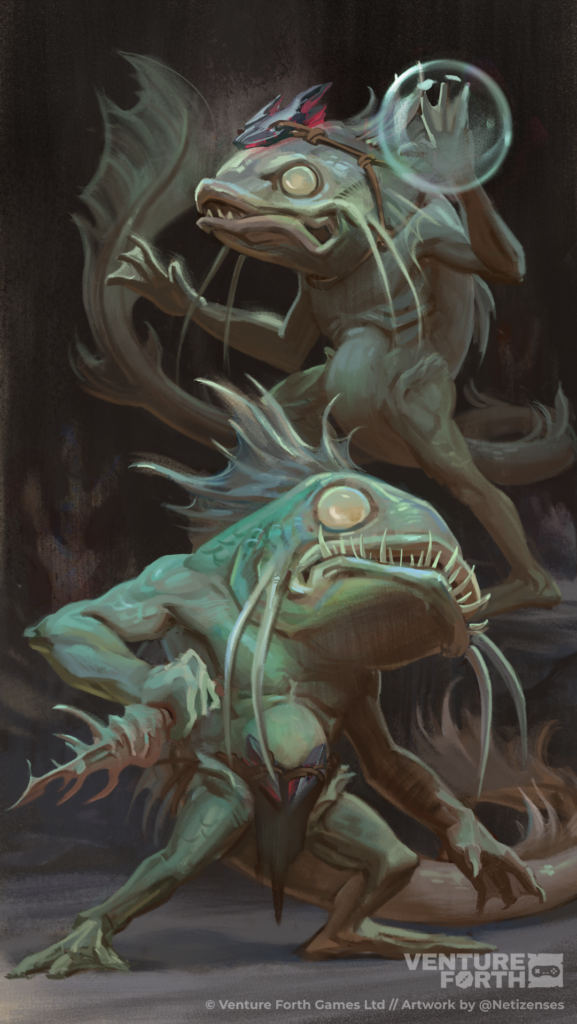
You might notice they’re wearing some very cool fashion accessories – it’s a type of material in this world called Vorandite which is similar in origin to something like obsidian… except it’s coming from a very dark and evil place.
Art style analysis
The whole point of our ‘concept art testing blob’ was to see if our unifying journal aesthetic theory actually held true across a range of styles and gameplay elements. In fact, if you go all the way back to the first ever devblog, I mentioned that one of our two primary goals was to start refining the art style.
Our entire idea was based on the cohesiveness of an artist’s sketchbook. Even though we’d all seen what Sophie had been creating, we still made a point of viewing all of the artwork together and deciding as a team if this was the correct direction for Garrison.
All these months later (we actually had the meeting in late February), we were finally able to check this box. The art style for Garrison had been set.
What’s next
There’s a lot of artwork required for this game. Thousands of individual pieces, if I had to take a rough guess. The good news is that they aren’t all required immediately – first and foremost, we’re working towards completing everything we need for the prototype.
This also includes implementing the UI, which is something I’ve been tinkering with for a while. The designs, I mean. No way I could implement that into Unity!
It’s been the bottleneck for getting the proof of concept (previously referred to as the MVP or minimal viable product) into a position where we’re happy to let people have a go at the game for the first time.
Once we have that and we’ve tested the core gameplay loop, the proof of concept will evolve into v0 of the prototype. Leon (developer) has been very forward-thinking with how he’s designed the game thus far so it’ll be a very natural progression. At least, that’s what he tells me.
Community Q & A
Imagine me, if you will, in a car park at the base of Mam Tor (a popular hiking destination in England). I arrived early, because one of my most irrational fears is not being able to find a parking spot, and struck up a conversation with a couple whilst in the queue for a coffee.
They had a very handsome dog called Link and, naturally, I was able to parlay that into a conversation about Garrison. After showing them a few different monsters (they both really liked the Wyvern), I was asked this:
Will it work a bit like Monster Hunter or The Witcher in that you can get upgrades from defeating monsters?
If I haven’t already said this before, I know I’ll definitely say it again – the answer is both yes and no.
The two games mentioned are quite different in a lot of their core mechanics (which I’m not going to delve into here) but at the heart of them both is a system familiar to all video game players: defeat monsters, become stronger.
That, of course, exists in this game, too. We have potion crafting and item upgrading, both reliant on the player sending characters out into the world who return with various different reagents – which could be plants, monster organs, rare minerals…
What I think is more interesting to mention, which will be elaborated on in an upcoming devblog, is how monsters are actually defeated. This game plays out asynchronously, meaning there isn’t actually any combat – you send characters to fight monsters and it happens without player input.
The challenge of the game, then, is making sure the characters are properly equipped to defeat the monsters they’ll face. Once the UI is successfully implemented we’ll be testing our planned core gameplay loop to find out if it’s actually as fun as we think it’s going to be!
Cheers, Andrew