I’m a genuine believer in the compound effect – something you may know as aggregate marginal gains or perhaps even Kaizen – which is where small, continual effort builds up to a massive success over time.
Pretty much every day for the last few years I’ve been chipping away at Garrison.
Most often I’ll be writing something – stories, application forms, design briefs and occasionally devblogs. The most fun I have – by far – is working with Sophie (artist) on creative briefs and chatting with Leon (developer) about how the game is actually going to function.
After all of our hard work, I’m beyond excited to say that the first major milestone for this project has been achieved. Almost exactly one year after work first started on Garrison, we finally have a completed prototype ready for testing.
Move slow and fix things
When we first started figuring out how to make this game, one thing we all agreed on was not wanting to put the game into players hands until we had enough assets to really sell the core idea of the game.
This goes against a lot of conventional wisdom but, given that Garrison is played through a journal – the imagery (which I constantly refer to as our ‘journal aesthetic’) has to do a lot of the heavy lifting.
I hadn’t really realised how many assets we had until Sophie started transferring file ownership over, prompted by her cloud storage rapidly approaching its limits. Fast forward a couple of weeks and I’m sat in Manchester with Leon for an offline project catch up.
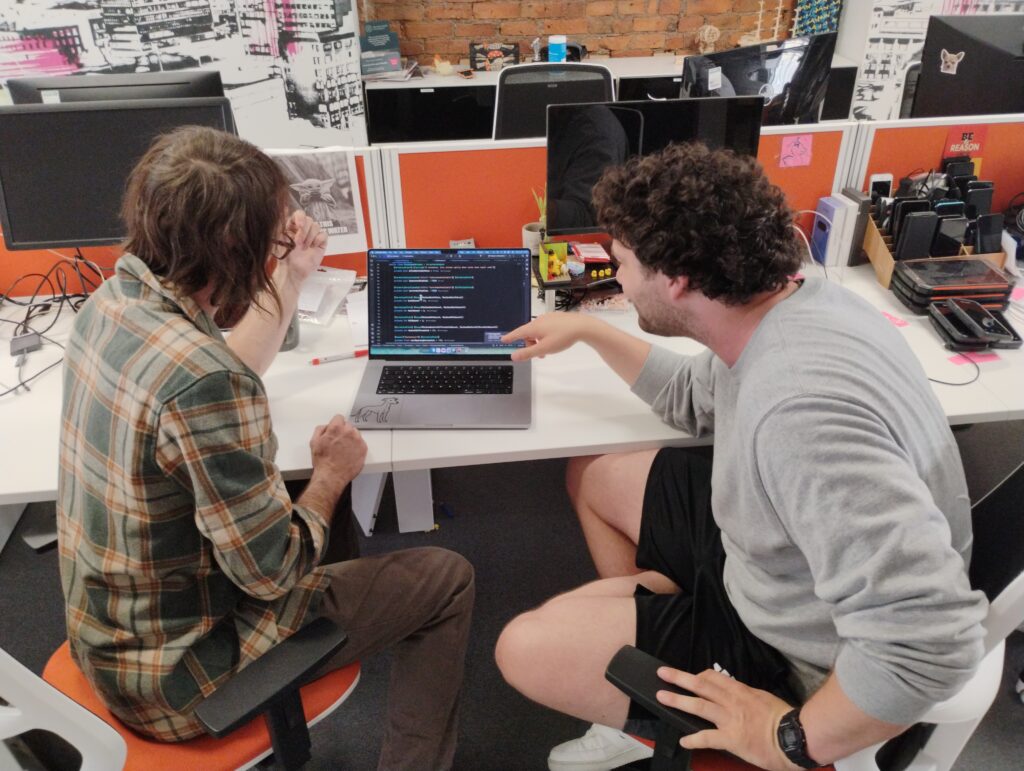
After chatting about our stockpile of game art, he casually drops into conversation that he could potentially get the prototype finished in about 2 or 3 weeks. Up until this point, actually playing Garrison had been more of an abstract idea. We knew it was going to happen at some point but we just didn’t know when.
Even though this conversation happened back in June, I think it’ll always stay with me. One of those moments where your hairs stand on end. After all the time spent creeping this project forward, we were finally ready to pull it all together.
Designs from doodles
Although we’d created assets for characters, monsters and items, when it came to the user interface (UI) all we had were some white box doodles I’d thrown together in Microsoft Paint many months earlier.
Originally we’d planned on adding another member to the team that’d handle the UI. As time went on and we got a better idea of the artstyle for the game, having things drawn in the same style as the rest of the game just made sense – and there’s no one on earth better positioned to handle that than Sophie.
Once we’d had a bit of a chat and made a plan, what followed was a frantic couple of weeks turning my very rough ideas into something that complimented all of our existing artwork.
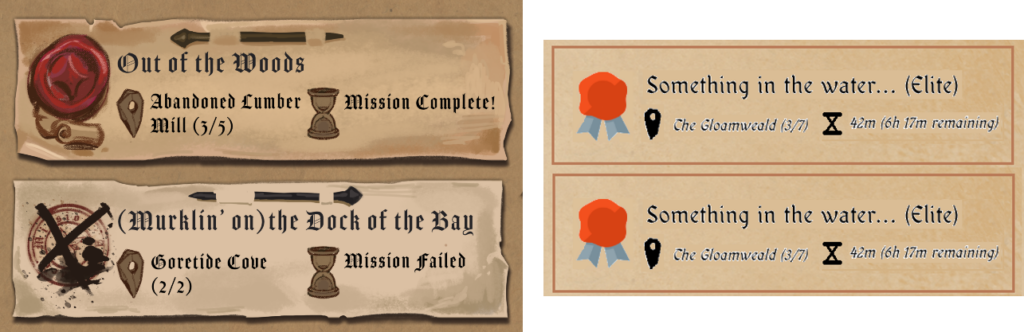
I’m not going to sit here and say the entire process was rainbows and unicorns. My original UI designs hadn’t been looked over in a while and, after throwing ourselves into the process at full force, it became apparent there were still a few things that needed ironing out.
There were two realisations we had part-way through the design process. First up, we couldn’t make everything look like it was a journal. Using a lot of medieval manuscripts as inspiration, we settled on a blend between different art styles (some more journal, some more manuscript) which all works together to create a better, clearer version of our journal aesthetic.
Secondly, a lot of what we were creating wasn’t quite papery enough. It didn’t give the sense journal to anywhere near the degree needed for players to suspend their disbelief, so we had to go back to the drawing board on that. Which, as we all agreed, was a very worthwhile delay.
The design process took up a lot of June, all of July and ran deep into August. When the end of the month rolled around, Leon got everything set up in Unity and we were able to look at Garrison for the first time.
It’s hard to describe the feeling, really. I was and still am proud of us as a team for what we’ve accomplished so far, but I’m also aware there’s still a long road for us to go. The next step in that process is to put the game into the hands of players and see what they think!
I’ll do a deep-dive in the next month or so, depending on how long it takes for me to put together a decent – and impartial – sample size.
Community Q & A
I spent a part of this July up in Scotland working with a Spanish production crew on a program called Cazadores de imágenes (which translates as ‘Image Hunters’ for any non-Spanish speakers reading this). They were hoping to find basking sharks but, as a result of the heatwave, it didn’t happen.
As the week went on, we naturally got talking about the different projects we were all working on and I was very quick to show off some of the artwork for Garrison. After agreeing that it was all insanely cool, one of the crew (¡Un saludo para Coque si estás leyendo esto!) hit me with this:
Is the artwork made with AI?
This is a question I’ve been getting since the start of this project. I’ve not really felt the need to address it because I think, especially if you follow the devblog, it’s pretty clear that this project is human made.
It’s interesting though because AI itself is quickly becoming unavoidable. You can’t even do a search online without being presented an AI overview. It’s like plastic. It exists in pretty much everything – including us as a species. Yep, you read that correctly – more than likely there’s microplastics in your bloodstream right now.
As a small studio, there are places where using AI would undoubtedly speed things up for us. The thing is, when you add in the environmental impact of using AI (if you aren’t aware, it’s really bad) and the fact that it’s essentially just copying a load of other people’s work, it’s not something I want to be associated with this project and this studio.
Cheers, Andrew